How does the electric vehicle Heat Pump works
The range of electric vehicles at low temperatures is increasingly attracting people's attention, and heat pumps, as a mature solution in the household and industrial fields, are gradually being welcomed by mainstream electric vehicle manufacturers. A heat pump is a device that extracts energy from the air for heating or cooling spaces. The working principle of a heat pump is opposite to that of a heat engine. A heat pump does work by inputting electrical energy and draws heat from the cold to the warm. This seems to violate the second law of thermodynamics, but this heat transfer is not spontaneous and requires input energy to achieve.
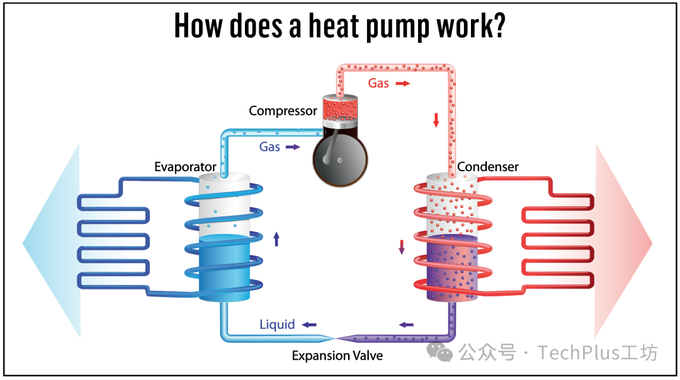
A heat pump is actually like a refrigerator, but the opposite is true: its function is exactly the opposite of a refrigerator in the kitchen. Household refrigerators contain refrigerant gas, which will heat up after compression. The compressed gas is transported to the condenser through some pipelines. The heat from the condenser is dissipated to cool the refrigerant gas, which is then transported to the evaporator pipeline. Due to the evaporator being larger than the condenser, the pressure drops and the liquid refrigerant evaporates into a gaseous state, absorbing heat from the surrounding environment. The temperature decreases accordingly, achieving a cooling effect.
The electric vehicle heat pump absorbs heat from the external air through the evaporator, compresses the refrigerant, and then uses the heat from the condenser to increase the temperature inside the battery or car. A reversible heat pump can also heat or cool batteries. If it is cooling, the excess heat generated by the battery's operation can be recovered, and while cooling the battery, it can also be used to heat the carriage, killing two birds with one stone.

The main components of a heat pump include the following:
Compressor: The compressor is the heart of a heat pump. It uses electricity to compress the refrigerant, increasing the pressure and temperature of the refrigerant.
Condenser: The condenser is located outside the heat pump. A condenser is a place where refrigerant releases heat to the surrounding air.
Evaporator: The evaporator is located inside the heat pump. It is the place where refrigerant absorbs heat from indoor air.
Expansion valve: An expansion valve is a small device used to reduce the pressure of refrigerant, transforming it from liquid to gas.
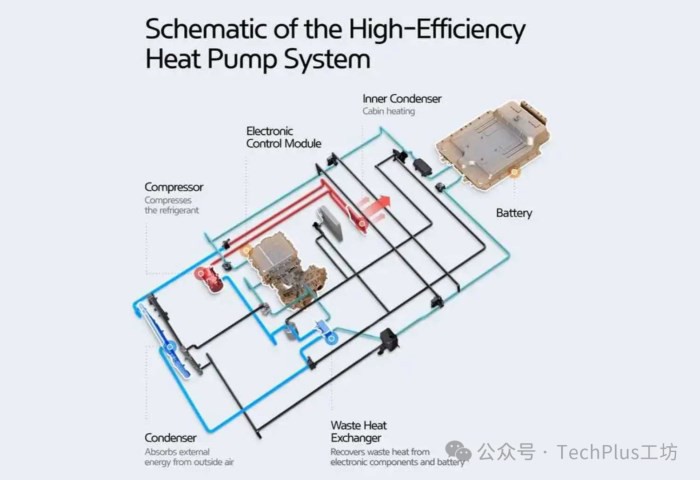
Heat pumps can increase the range of electric vehicles in winter. Heat pumps do not require electricity to generate heat, they only pump heat from outside into indoors. The capacity consumed by the heat pump during this process is much less than that of PTC direct heating. The heat pump can change its operating mode as needed, allowing for both heating and cooling.
Although heat pumps are becoming increasingly popular and have many advantages, the cost of heat pump systems is still high. During the operation of heat pumps, the compressor will continue to work, which may bring noise problems. Compared to traditional electric heating methods, heat pump systems are more complex, have more components, and have relatively lower reliability.