

How to solve the thermal issue of outdoor LED display?
With the gradual increase in temperature, the LED display is also more likely to heat up. High temperature will cause the failure probability of electronic components to increase rapidly, resulting in a decrease in the reliability of the LED display.
In order to control the temperature of the electronic components inside the led display screen so that it does not exceed the specified maximum allowable temperature under the working environment conditions of the led display screen, the heat dissipation design of the led display screen is required. The heat dissipation design of led display, how can low cost, high quality, is the content of this article.
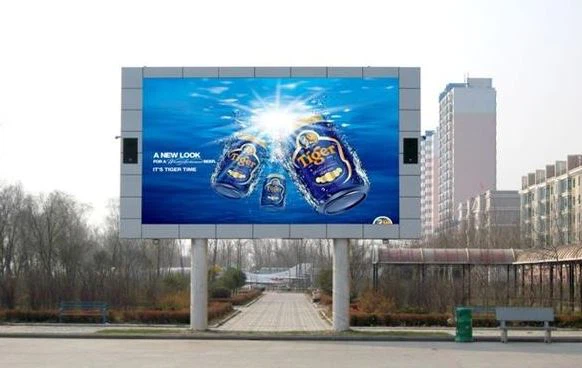
There are three basic ways of heat transfer: heat conduction, convection and radiation.
Heat conduction: The heat conduction of gas is the result of collision of gas molecules when they move irregularly. The heat conduction in metal conductors is mainly accomplished by the movement of free electrons. Heat conduction in non-conductive solids is achieved by the vibration of the lattice structure. The heat conduction mechanism in the liquid mainly relies on the action of elastic waves.
Convection: refers to the process of heat transfer caused by relative displacement between various parts of the fluid. Convection only occurs in the fluid, and it must be accompanied by the phenomenon of heat conduction. The heat exchange process that occurs when fluid flows over the surface of an object is called convective heat transfer. The convection caused by the different densities of the hot and cold parts of the fluid is called natural convection. If the movement of the fluid is caused by external forces (fans, etc.), it is called forced convection.
Radiation: The process by which an object transfers its ability in the form of electromagnetic waves is called thermal radiation. Radiant energy transfers energy in a vacuum, and there is a conversion of energy form, that is, thermal energy is converted into radiant energy and radiant energy is converted into thermal energy.
When choosing a heat dissipation method, the following factors should be considered: heat flow density, volume power density, total power consumption, surface area, volume, working environment conditions (temperature, humidity, air pressure, dust, etc.) of the led display. According to the heat transfer mechanism, there are heat dissipation methods such as natural cooling, forced air cooling, direct liquid cooling, evaporative cooling, thermoelectric cooling, and heat transfer by heat pipes.
The heat dissipation design method of LED screen
The heat exchange area between the heating electronic parts and the cold air, and the temperature difference between the heating electronic parts and the cold air, directly affect the heat dissipation effect. This involves the design of the air volume entering the LED display box and the design of the air duct. When designing ventilation ducts, try to use straight ducts to transport air and avoid sharp bends and bends. Ventilation ducts should avoid sudden expansion or sudden contraction. The expanded angle should not exceed 20°, and the contracted cone angle should not exceed 60°. The ventilation ducts should be sealed as far as possible, and all overlaps should follow the direction of flow.
The key points of LED display cabinet design:
The exhaust hole should be located near the upper side of the box. The air inlet should be set on the lower side of the box, but not too low to prevent dirt and water from entering the box installed on the ground.
The design should make natural convection help forced convection. The air should circulate from the bottom to the top of the box, and a dedicated air inlet or exhaust hole should be used. The cooling air should be allowed to flow through the heat-generating electronic parts, and the air current should be prevented from short-circuiting. Filters should be installed at the air inlet and outlet to prevent debris from entering the box.
When designing, make sure that the air inlet and the air outlet are kept away from each other. Avoid repeated use of cooling air.
To ensure that the direction of the radiator cogging is parallel to the wind direction, the radiator cogging cannot block the wind path.
The fan is installed in the system. Due to structural limitations, the air inlet and outlet are often blocked by various obstacles, and its performance curve will change. According to actual experience, the air inlet and outlet of the fan should be 40mm away from the obstruction. If there is space limitation, it should be at least 20mm.


