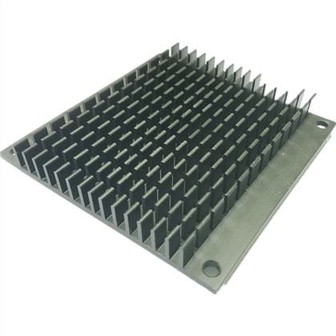
Introduction of common used Graphics card cooling heatsink
Due to the continuous rise of the core working frequency of the graphics card and the working frequency of the graphics memory, the heat generation of the graphics card chip is also increasing rapidly. The number of transistors in the display chip has reached or even exceeded the number in the CPU. Such a high degree of integration will inevitably lead to an increase in calorific value. In order to solve these problems, the graphics card will adopt the necessary heat dissipation method.
Pasive Cooling Extrusion Heatsink:
The heat dissipation mode of graphics card is divided into heat sink and heat sink with fan, also known as active heat dissipation and passive heat dissipation. Generally, some graphics cards with low working frequency adopt passive heat dissipation. This heat dissipation method is to install a heat sink on the display chip, and there is no need for a heat dissipation fan. Because the cooling capacity of the graphics card with lower working frequency is not very large, it is not necessary to use the cooling fan. In this way, while ensuring the stable operation of the graphics card, it can not only reduce the cost, but also reduce the noise in use.

Active Cooling Fan Cooler :
In addition to installing a heat sink on the chip, the active heat dissipation is also installed with a cooling fan. This active heat dissipation is required for graphics cards with high working frequency. Because higher working frequency will bring higher heat, it is difficult to meet the needs of heat dissipation if only one heat sink is installed, so the help of fan is needed, and it is more important for those users who use overclocking and those who need to use for a long time.

Liquid cooling module:
Liquid cooling is a mature cooling method for graphics cards. The application of liquid cooling technology in the computer field is not because air-cooled cooling has developed to the end, but because the specific heat of liquid is far greater than that of air. Therefore, liquid cooling heatsinks often have good thermal performance and can be well controlled in terms of noise. The liquid cooling of the graphics card generally includes the liquid cooling head of the graphics card, circulating pump, heat transfer fluid, heat exchanger, etc.

HeatPipe Heatsink:
The heat conduction process of heat pipe has high heat conduction performance. Compared with metal, the heat pipe per unit mass can transfer several orders of magnitude more heat, and has excellent isothermal and thermal switching performance. It is especially suitable for high-precision heat dissipation environment. It is worth noting that the heat pipe is only a high-efficiency heat conduction technology, which itself cannot dissipate heat. It must be matched with a heat sink such as a heat sink or a fan at the condensing end to finally dissipate heat. More and more graphics cards use heat pipes to dissipate heat.