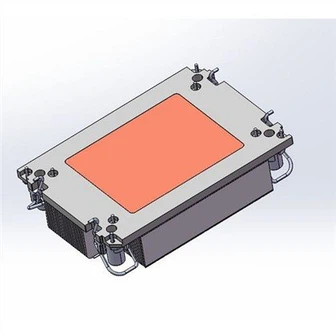
The heat dissipation problem of GPU server-thermosyphon heat dissipation technology
With the development of deep learning, simulation, BIM design, and AEC industry applications in various industries, under the blessing of AI technology virtual GPU technology, powerful GPU computing power analysis is required. Both GPU servers and GPU workstations tend to be miniaturized, modularized, and highly integrated. The heat flow density often reaches 7-10 times that of traditional air-cooled GPU server equipment. Due to the centralized installation of modules, there are a large number of NVIDIA GPU graphics cards with a large amount of heat, so the heat dissipation problem is very prominent. In the past, the commonly used heat dissipation design technology can no longer meet the requirements of new systems. Traditional water-cooled GPU servers or liquid-cooled GPU servers cannot be separated from the support of fans. Today we will analyze the thermosiphon heat dissipation technology.
At present, the thermosyphon heat dissipation technology on the market mainly uses a column or plate radiator as the body, a heat medium tube is inserted into the bottom of the radiator, a working fluid is injected into the shell, and a vacuum environment is established. This is a normal temperature gravity heat pipe . The working process is as follows: At the bottom of the radiator, the heating system heats the working fluid in the shell through the heat medium pipe. Within the working temperature range, the working fluid boils, and the steam rises to the upper part of the radiator to condense and release heat, and the condensate flows along the inner wall of the radiator. The reflux to the heating section is heated and evaporated again, and the heat is transferred from the heat source to the heat sink through the continuous cycle phase change of the working fluid to achieve the purpose of heating and heating.
1 The application of thermosyphon heat dissipation on GPU workstations
How does each generation of CPU cooler move step by step to the limit of contemporary theoretical performance. From the most primitive aluminum heat sink to the present, it is a good choice. You may think that since some small fins are so easy to use, are more and bigger fins better to use? However, the result is not the case. The farther the fins are from the heat source, the lower the temperature of the fins. When the temperature drops to the temperature of the surrounding air, no matter how long the fins are made, the heat transfer will not continue to increase.

When modern GPU computing power consumption enters the range of 75 to 350 watts or even higher, thermal design engineers turn to develop new heat dissipation methods. The heat pipe itself does not enhance the heat dissipation capacity of the radiator. Its function is to use heat conduction and heat convection at the same time to achieve a heat transfer efficiency much higher than that of the metal itself.
As early as 1937, the thermosiphon technology appeared. During normal operation, the liquid inside the heat pipe would boil, and the steam would reach the condensation end through the steam chamber, and then the steam would return to the liquid and then return to the heat source through the tube core. The tube core is usually in the sintered metal. However, if the heat pipe absorbs too much heat, the phenomenon of "heat pipe drying up" will occur. The liquid not only becomes steam in the steam chamber, but also becomes steam in the tube core, which prevents it from changing back to the liquid to return to the heat source, which greatly increases the thermal resistance of the heat pipe.
Now our highlight is coming-thermosyphon. Thermosyphon heat dissipation is not like a heat pipe, which uses a tube core to bring the liquid back to the evaporation end, but only uses gravity, coupled with some ingenious designs to form a circulation, and uses the liquid evaporation process as a water pump. This is not a new technology, it is very common in industrial applications with large heat release.
Generally speaking, the refrigerant inside the GPU will boil, flow upwards into the condensation side inside, change back to liquid and return to the evaporating side. There are two major advantages in theory:
1. Avoid heat pipes from drying up, and can be used for overclocking ultra-high performance chips
2. Because there is no need for a water pump, the reliability is better than traditional integrated water cooling
The most important point of thermosiphon heat dissipation is that its thickness will be reduced from the traditional 103 mm to only 30 mm (reduced to less than one-third), and the shape is relatively small and will not compromise performance. In order to facilitate processing of thermosyphon heat dissipation equipment, most manufacturers currently use aluminum materials. Copper is also used, and the temperature may be lowered by 5-10 degrees, only for GPU servers that generate more heat.