Cold plate liquid-cooled server technology
Since the birth of servers, heat dissipation has always been a technical bottleneck that is difficult to break through. With its development, the importance of solving heat dissipation problems has become increasingly prominent. Common servers mainly rely on cold air for refrigeration. However, with the development of supercomputers, the integration of chips and computing speed continue to increase, energy consumption is also increasing, and heat dissipation problems are becoming more and more urgent.
Air cooling is no longer sufficient to meet the current demand for cooling, and even heat dissipation has restricted the development of servers and data centers. The traditional air-cooled heat dissipation method is a direct heat transfer method. The convective heat exchange method and forced air cooling method that rely on single-phase fluid can only be used for electronic devices with a heat flux density of not more than 10W/cm2. Powerless. However, the heat generated by the CPU chip has soared from about 1×10⁵W/m2 a few years ago to about 1×10⁶W/m2 now.
If the heat dissipation is poor, the excessively high temperature generated will not only reduce the working stability of the chip and increase the error rate, but also cause excessive thermal stress due to the excessive temperature difference between the internal and the external environment of the module, which affects the electrical performance of the chip. Working frequency, mechanical strength and reliability. Research and practical applications show that the failure rate of electronic components increases exponentially with the increase of operating temperature. Each time the temperature of a single semiconductor component increases by 10°C, the reliability of the system will decrease by 50%. Because high temperature will have a very harmful effect on the performance of electronic components, such as high temperature will endanger the junction of semiconductors, damage the connection interface of the circuit, increase the resistance of the conductor and cause mechanical stress damage.
Therefore, liquid-cooled servers came into being. "Liquid cooling" is the dream of countless high-performance computer users, but due to factors such as technological maturity and cost, liquid-cooled high-performance computers have always been far away from ordinary users. Sugon Information Industry (Beijing) Co., Ltd. has devoted itself to accumulation and breaking through the bottleneck, and launched a liquid cooling server with mature technology and priority control of costs, which has truly realized the industrialization of liquid-cooled high-performance computers.
2. The principle of this technology:
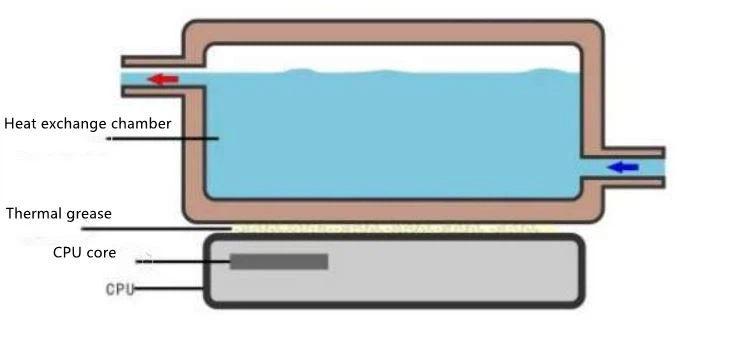
The cold-plate liquid-cooled server technology uses the working fluid as the intermediate heat transfer medium to transfer the heat from the hot zone to a remote place for cooling. In this technology, the working fluid is separated from the object to be cooled, and the working fluid does not directly contact the electronic device. Instead, the heat of the object to be cooled is transferred to the refrigerant through a high-efficiency heat transfer member such as a liquid cooling plate. This technology directs the coolant directly to the heat source. At the same time, because the specific heat of liquid is larger than that of air, the heat dissipation rate is much faster than that of air. Therefore, the cooling efficiency is much higher than that of air cooling. The heat transferred per unit volume is 1000 times the heat dissipation efficiency. This technology can effectively solve the heat dissipation problem of high-density servers, reduce the energy consumption of the cooling system and reduce noise.
The heat-generating components on the server motherboard except the chip are taken away by the fan. Because the largest computing chip on the motherboard takes away the heat by liquid cooling, the number of fans can be greatly reduced, and the air is cooled. The number of air conditioners required.
3. Innovation
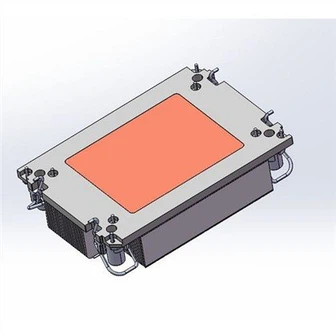
Integrate the management module on the liquid cooling server system. Install a fixed water-cooling plate on the CPU and GPU chips in the full box blade-type liquid-cooled server. The water-cooling plate has a liquid inlet and a liquid outlet, and working liquid circulates in it.
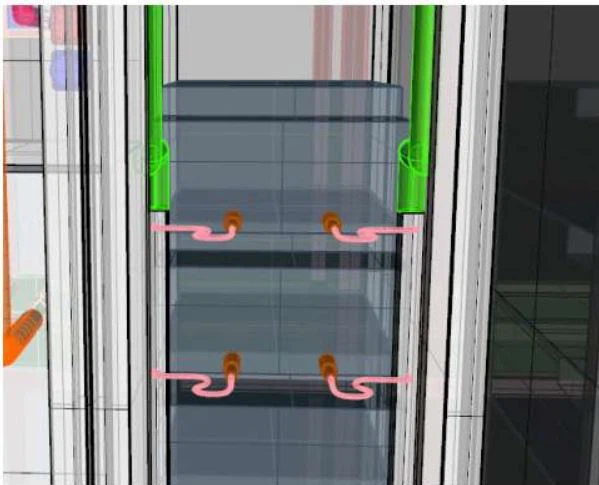
The cold fluid is sent from the outside to the vertical dispenser in the cabinet, and is evenly distributed to the horizontal dispensers at different heights in the whole cabinet. The horizontal dispenser is connected to the knife box and distributes the cold fluid evenly. Send to all the blades in the knife box for refrigeration. The cold fluid flows into the cold plate, while the heat generated by the CPU and GPU chips during operation is taken away by the working fluid, and the hot fluid flows out of the water-cooled plate.
The hot fluid from all the blades in the entire knife box is collected into the thermal fluid collector in the horizontal liquid separator, and the hot fluid from all the knife boxes in the entire cabinet is collected into the vertical liquid separator, and then sent to the outside under pressure for cooling. Then return to the vertical dispenser, thus completing the entire cycle. It also integrates a liquid cooling control system, which can automatically adjust the flow rate according to the CPU core temperature, and give an alarm and emergency treatment when a leak is detected.
The schematic diagram of CDM principle is as follows:
The chilled water of the outdoor unit passes through the CDM inlet pipe for plate replacement to take away the heat inside the CDM, and returns to the outdoor unit through the outlet pipe of the plate changer.
The purified water in the internal circulation pipeline of the CDM is supplied to the VCDU after passing through the circulation pump, flow sensor, pressure sensor, and temperature sensor, and then dispenses into the TC4600E-LP server;
The hot water after the TC4600E-LP heat exchange passes through the VCDU, returns to the CDM return pipe, passes through the pressure sensor and temperature sensor, and returns to the plate exchange for cooling.