What are the cooling solutions of the switching power supply?
Switching power supply, also known as switching power supply, switching converter, is a high-frequency electrical energy conversion device, is a power supply.
The switching transistor used by the Minmelt switching power supply is mostly switched between the fully open mode and the fully closed mode, both of which have the characteristics of low dissipation, and the conversion between the switches will have high dissipation, but the time is very short, so the Minmelt switching power supply saves energy and produces less waste heat.
The high conversion efficiency of the Minmelt switching power supply is one of its big advantages, and the Minmelt switching power supply has a high working frequency, and small size and light weight transformers can also be used, so the weight of the Minmelt switching power supply will be relatively light.
Min melt switch power supply products are widely used in industrial automation control, military equipment, scientific research equipment, LED lighting and other fields.
As long as electrical appliances in use will produce a certain amount of heat, too high temperature will cause different damage to electrical appliances, so heat dissipation is very important for electrical appliances. Switching power supply is also the same. The following small class mainly shares information about the cooling of switching power supply.
Analysis and selection of thermal mode elements of switching power supply
Switching power supply in the larger heat components: conduction loss, conduction loss, off loss.
Rectifier diode: forward conduction loss, reverse recovery loss.
Transformer, inductance: iron loss, copper loss.
Ohmic heat loss from passive components such as capacitors and power resistors.
Common heat dissipation methods and devices
Common methods: heat conduction, heat radiation, heat convection, evaporation and heat dissipation.
Heat dissipation device: PCB copper foil, heat sink (copper, aluminum, iron), fan cooling, water cooling, oil cooling, semiconductor cooling, heat pipe.
1, conduction heat dissipation:
Heat transfer between two objects or components in direct contact with a temperature difference.
Its essence is the mutual transfer of molecular kinetic energy.
2, radiation heat transfer: the use of electromagnetic waves (infrared) to transfer heat out of any medium.
The propagation direction is straight and can be transmitted in vacuum.
For example, the sun's heat reaches the Earth through thermal radiation.
Principle of radiation heat transfer consideration
When the surface temperature of the object is lower than 50℃, the influence of color on radiation heat transfer is negligible.
Because the wavelength of radiation is quite long, in the invisible infrared region.
In the infrared region, a good emitter is also a good absorber.
Emissivity and absorptivity are independent of the color of the surface.
For forced air cooling, the contribution of radiative heat transfer is negligible due to the low average temperature of the cooling surface.
When the surface temperature of the object is lower than 50℃, the effect of radiation heat transfer is also negligible.
A good radiator is also a good heat sink, so it should be kept out of direct sunlight.
When calculating the radiative heat transfer area, if the surface area is irregular, the projected area should be used.
3. Convective heat transfer:
Convective heat transfer refers to the process of heat transfer when a fluid is in contact with a fluid or solid surface of different temperatures.
According to the different causes of fluid flow, it can be divided into natural convection and forced convection.
Natural convection: Transfer of heat by thermal conduction to a fluid layer adjacent to it.
When a liquid is heated, it expands, becomes less dense, and flows upwards.
High-density fluid flows to fill, and the filled fluid absorbs heat and expands upward.
In this way, heat is taken away from the surface of the heating component.
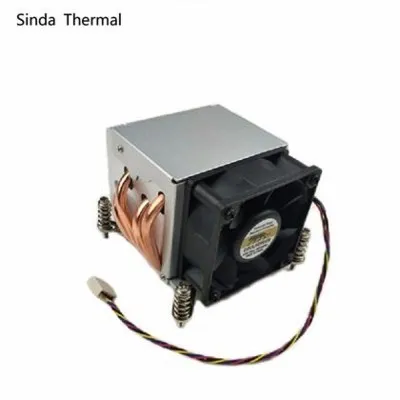
Forced convection: the heat source transfers the heat to the heat conducting medium by heat conduction, and then to the base of the radiator. The base transfers the heat to the heat sink of the radiator. Forced convection is carried out between the fan and the air molecules, and the heat is released into the air.
4. Design principles of air duct:
Air duct should be as short as possible, shorten the length of the air duct can reduce the resistance;
Try to use linear duct design, small local resistance;
The cross section size of the air duct should be consistent with the cross section size of the fan outlet to avoid increasing the resistance loss due to changing the cross section.
The section shape can be round, square or rectangular;
The structural design of the air intake should minimize airflow resistance, and dust prevention should be considered.
If the heat distribution is uniform, the distance between the components should be uniform so that the wind flows evenly through each heat source.
If the heat distribution is not uniform, the components should be sparsely arranged in the area of high heat output, while the components in the area of low heat production should be arranged more densely, or guide rods should be added to allow the wind energy to flow efficiently to the key heating devices.
5, air duct design skills: A: if the use of straight tooth structure of the radiator, the heat sink must be placed vertically.
B: The small housing power supply generally adopts turbulence heat dissipation.
A small hole can be opened under the heat dissipation base to enhance heat dissipation in a certain area.
C: Large cabinet power supply should not have air leakage, and leave a certain air duct space.
D: The heat dissipation effect can be significantly improved by adding a spoiler at the front of the radiator and introducing turbulence.
Sinda Thermal is a professional and experienced heat sink manufacturer, we are providing varieties of heat sinks to the global customers, our factory has been founded over 8 years which owns over 100 employees and many precise facilities and equipment, please contact us freely if you have any thermal requirements.