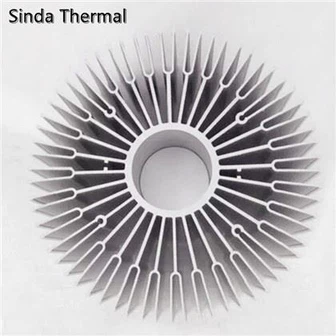
Does the heat dissipation of the LED have a connection with the service life of the LED?
LED is known as the fourth-generation lighting source or green light source. It has the characteristics of energy saving, environmental protection, long life, and small size. It can be widely used in various indications, displays, decorations, backlight sources, general lighting and urban night scenes. In recent years, some economically developed countries in the world have launched fierce technical competitions around the development of LEDs. Among them, LED heat dissipation has always been an urgent problem to be solved! Research data shows that if the LED chip's light emission is 100% when the junction temperature is 25 degrees, then when the junction temperature rises to 60 degrees, its light emission is only 90%; when the junction temperature is 100 degrees, it drops to 80%; 140 The degree is only 70%. It can be seen that it is very important to improve the heat dissipation and control the junction temperature.
In addition, the heat of the LED will cause its spectrum to move; the color temperature increases; the forward current increases (when the constant voltage is supplied); the reverse current also increases; the thermal stress increases; the phosphor epoxy resin aging accelerates, etc. There are various problems, so the heat dissipation of LED is the most important issue in the design of LED lamps.

How is the junction temperature of the LED chip produced?
The reason why the LED heats up is because the added electric energy is not all converted into light energy, but part of it is converted into heat energy. The luminous efficiency of LED is currently only 100lm/W, and its electro-optical conversion efficiency is only about 20-30%. In other words, about 70% of the electrical energy is turned into heat.

High-power LED white light applications and LED chip heat dissipation solutions
Nowadays, LED white light products are gradually used in various fields and put into use. People feel the amazing pleasure brought by its high-power LED white light while worrying about its various practical problems!
First of all, from the nature of high-power LED white light itself. High-power LEDs still have poor luminescence uniformity and short life of the sealing material, especially the heat dissipation problem of the LED chip is difficult to solve well, and the expected application advantages of white light LEDs cannot be brought into play. So the heat dissipation problem of high-power LED white light cannot be solved?
Of course it is possible to solve it. In response to the negative problem of simply increasing the chip area, LED white light manufacturers introduced water cooling based on the improvement of the electrode structure and the structure of the flip chip. The water cooling plate is directly attached to the heat dissipation core, and the water pump and the heat sink are connected through a heat pipe The complete heat dissipation system will effectively solve the heat dissipation problem. In fact, the use of water cooling to dissipate heat not only solves the space problem, but also greatly improves the efficiency. Effectively reduce the junction temperature, then the amount of light will be greatly increased, and the LED equipment will be more energy-efficient and efficient. Sinda Thermal is devoted in LED thermal solutions over plenty of years and have the experiences to make a contribution to LED industry.