The cooling method of LED heatsink
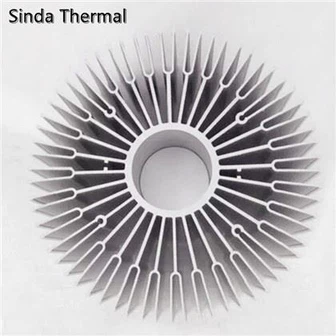
Aluminum fins
This is the most common way to dissipate heat. Aluminum fins are used as part of the housing to increase the heat dissipation area.
Thermally conductive plastic shell
Using LED insulating and heat-dissipating plastic instead of aluminum alloy to make the heat sink can greatly improve the heat radiation capacity.
Surface radiation treatment
The surface of the lamp housing is treated with radiant heat. The simple method is to apply radiant heat dissipation paint, which can take the heat away from the surface of the lamp housing by radiation.
Aerodynamics
Using the shape of the lamp housing to create convective air, this is the lowest cost way to enhance heat dissipation.
fan
Long-life and high-efficiency fans are used inside the lamp housing to enhance heat dissipation, which has low cost and good effect. However, it is more troublesome to change the fan, and it is not suitable for outdoor use. This kind of design is relatively rare.
Heat pipe
Using heat pipe technology, the heat is conducted from the LED chip to the heat dissipation fins of the housing. It is a common design in large lamps, such as street lamps.
Liquid bulb
Using liquid bulb encapsulation technology, a transparent liquid with high thermal conductivity is filled into the bulb of the lamp body. This is the only technology that uses the light-emitting surface of the LED chip to conduct heat and dissipate heat in addition to the principle of light reflection.
The use of lamp holder
In household-type low-power LED lamps, the internal space of the lamp holder is often used to partially or completely insert the heating drive circuit. In this way, a lamp cap with a larger metal surface like a screw cap can be used to dissipate heat, because the lamp cap is tightly connected to the metal electrode of the lamp holder and the power cord. Therefore, a part of the heat can be taken out and dissipated.
Heat conduction and heat dissipation
The purpose of the heat dissipation of the lamp housing is to reduce the working temperature of the LED chip. Since the expansion coefficient of the LED chip is very different from the expansion coefficient of our commonly used metal heat conduction and heat dissipation materials, the LED chip cannot be directly welded to avoid high and low temperature thermal stress to damage the LED chip. The latest high thermal conductivity ceramic material, the thermal conductivity is close to aluminum, and the expansion system can be adjusted to synchronize with the LED chip. In this way, heat conduction and heat dissipation can be integrated, and the intermediate links of heat conduction can be reduced.
PVC improved materials
With heat conduction function, secondary packaging.