



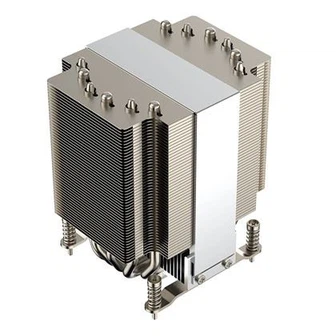
Heat Pipe CPU Heat Sink For Server
Heat pipe heat sinks are an increasingly popular choice for cooling server components. These devices use a combination of thermal conduction and convection to efficiently dissipate the heat generated by processors, memory modules, and other internal hardware. By utilizing this method of cooling, servers can remain cooler, run faster, and last longer than their traditional air-cooled counterparts. In this article we will discuss the basics of how heat pipe heat sinks work as well as some advantages offered by incorporating them into your server setup. At its most basic level, a heat pipe is simply a hollow tube filled with liquid that acts as a conductor between two points on the same circuit board or component. When one side of the tube heats up due to energy being released from nearby components (such as processors), it causes molecules within the liquid to move around more quickly and transfer heat away from those components onto another point on the board or component where it can be dispersed safely outwards. This process is known as thermal conduction and helps keep temperatures low inside computer systems while also providing efficient passive cooling for their parts.
Product Introduction
Heat pipe heat sinks are an increasingly popular choice for cooling server components. These devices use a combination of thermal conduction and convection to efficiently dissipate the heat generated by processors, memory modules, and other internal hardware. By utilizing this method of cooling, servers can remain cooler, run faster, and last longer than their traditional air-cooled counterparts. In this article we will discuss the basics of how heat pipe heat sinks work as well as some advantages offered by incorporating them into your server setup. At its most basic level, a heat pipe is simply a hollow tube filled with liquid that acts as a conductor between two points on the same circuit board or component. When one side of the tube heats up due to energy being released from nearby components (such as processors), it causes molecules within the liquid to move around more quickly and transfer heat away from those components onto another point on the board or component where it can be dispersed safely outwards. This process is known as thermal conduction and helps keep temperatures low inside computer systems while also providing efficient passive cooling for their parts.
The main advantage offered by using these pipes is that they don't require any active power source like fans or pumps do — instead relying solely on natural convection currents created when heated air rises off hot components while cool air takes its place below them. This allows you to reduce noise levels significantly compared to traditional fan-based solutions without compromising performance since there's no need to constantly replace old warm air with new cold one throughout operation time frames either! Additionally, because they're so small they won't take up too much space within your system either which makes them ideal for cramped environments such as blade servers or laptops where every inch counts towards overall efficiency gains over larger setups containing multiple parts working together simultaneously.
In terms of practical applications for servers specifically though, these pipes are often used alongside copper fins in order to further increase surface area available for transferring away excess energy produced during operations - especially when dealing with high-end processor models capable generating huge amounts of electricity at once (i.e., Intel Xeon E7 series). The combination ensures that all areas are cooled evenly which prevents hotspots from forming near sensitive components like RAM chipsets; ultimately leading better overall stability across entire systems running demanding workloads day after day without any issues whatsoever! Overall then if you're looking into ways of improving performance while keeping costs down at same time then look no further than investing some money into quality heat pipe/fin combo units designed specifically tailored towards server setups - they'll prove invaluable over long haul both now today future years come thanks their impressive ability dissipate large amounts energy quickly effectively without needing extra power sources doing so!

Thermal simulation

Factory and workshop

Certificates


Sinda Thermal is a leading thermal manufacturer in China, our factory was founded in 2014, and located in Dongguan city, China, we are offering varieties of heatsinks and other precious metal parts. Our plant possesses 30 sets advanced and high precious CNC machines and stamping machines, also we have many testing and experiment instruments and professional engineering team, so our company can manufacture and provide high quality products with high precision and excellent thermal performance. Sinda Thermal is commited to a range of heat sinks which are widely used in new power supply, New energy vehicles, Telecommunications, Servers, IGBT, and Madical. All the products accord with Rohs/Reach standard, and the factory is qualified by ISO9001 and ISO14001. Our company has been a partner with many customers for good quality, excellent service and competitive price. Sinda Thermal is a great heat sink manufacturer for the global customers .
Hot Tags: heat pipe cpu heat sink for server, China, manufacturers, customized, wholesale, buy, bulk, quotation, low price, in stock, free sample, made in China
You Might Also Like
-

Aluminum Zipper Fin Heat Pipe 2U Server CPU Radiator For LGA4189
-

Aluminum Zipper Fin Vapor Chamber 1U Server CPU Heat Sink For LGA4189
-

Copper Zipper Fin Vapor Chamber 2U Server Active CPU Heat Sink With Fan For LGA3647 Narrow
-

Copper Skived Fin Heat Sink With Cooling Fan 1U Server CPU Cooler For LGA1700
-
Intel LGA1700 Server CPU Heatsink
-

Intel LGA 4189 2U Heat Pipe CPU Cooler
Send Inquiry
